Showing posts with label Carl Sagan. Show all posts
Showing posts with label Carl Sagan. Show all posts
or Nature AND Nurture
 | Nature & Nurture Changing the Nature of How We View Nature The Story Of Christian The Lion Somehow, in the those groovy Austin Powers days of England 1969, at Harrods of London, Australians John Rendall & Anthony Bourke bought a lion cub they called Christian. |
"Animals have intelligences different from ours; they are not just primitive models of our achievements."
Stephen Jay Gould
Yes, this will appear as attributing human qualities to a non-human animal. And yes to some, this will seem to be pandering to our own emotions... However, this appearance alone shouldn't be a reason to ignore it.
Because awareness and emotions are precisely the point.
Yes, I want scientific rigor but I don't think we need to lose science in the process of examining our presumptions. On the contrary, we may gain what we lost from a priori blocking or ruling certain things out. Or in other words eliminating our prejudice. I think the fear of anthropomorphism can be blinding or confounding too. Is it possible that some of the "human characteristics" we see in animals are not projections of ourselves after all? We share evolutionary conditions, history and ancestry with other creatures. Can we be blinding ourselves to characteristics we call uniquely human but that may be capacities shared by our ancestors and still today with our living relatives? Taking a big picture view, another point is that evolution also converges to certain useful adaptations. That too shouldn't be ignored. Perhaps even distantly relatived animals may have developed parallel systems. So... is it possible we have been guilty of evolutionary hubris? Are we really the only ones to be conscious and feel?
I don't think humans invented emotions but for the longest time we denied any other species this capacity. An arrogance that saw animals as no better than souless machines, automated by instinct alone. Animals were even denied feeling pain. The atrocities visited on them by this view really does whittle away at our claim to be human(e). It has also distorted our view of their nature, as well as our own.
The extremes on both sides of the issue have not been helpful. I find neither animal activists nor animal abusers, are right. It seems to me that both argue in the name of a human superiority, one moral, the other divine. A balanced, more empirical and less ideological perspective on our relationship with our fellow creatures may be called for. We interact and share the planet with other animals who share a common evolutionary origin, in an ecological whole. Humans are omnivores, we have evolved to eat some meat, we need to live with other animals either directly or indirectly. We are also social with them, have pets and have an emotional or psychological reliance on them. While engaging in these behaviors and interactions, it is not necessary for us to be overly guilty but it's also not necessary to deny that animals have feelings and to treat them with disrespect or cruelty. While we need to eat and live, we do not need to make animals suffer unnecessarily... We may find out that in treating them with compassion and respect they may just respect or even love us back.
| Changing the Nature of How We View Nature No one is advocating that you adopt a lion cub.  The point is the assumption that it will end in tears... It did... but in tears of joy. The point is the assumption that it will end in tears... It did... but in tears of joy.Humans — who enslave, castrate, experiment on, and fillet other animals — have had an understandable penchant for pretending animals do not feel pain. A sharp distinction between humans and 'animals' is essential if we are to bend them to our will, make them work for us, wear them, eat them — without any disquieting tinges of guilt or regret. It is unseemly of us, who often behave so unfeelingly toward other animals, to contend that only humans can suffer. The behavior of other animals renders such pretensions specious. They are just too much like us. (Carl Sagan co-written with Dr. Ann Druyan) While I don't think anthropomorphizing is necessarily a good thing. What I'm saying is that the other extreme... a professional paranoia of recognizing and calling a spade a spade dates back at least to Descartes and his idea that since animals (viewed mechanically) don't think therefore they don't feel either. Ridiculous logic and not science. But a underlying metaphysics that has been guiding science perhaps for too long.  It is an illusion to believe that instinct, thought and emotion aren't intrinsically related. Both consciously and unconsciously they intimately interact. Separating them out may be a handy logical trick only in your head, with very little support from empirical reality outside of it.  While humans have a very high level of consciousness could it be that as far as awareness or capacity are concerned, things are little more shared and less exclusive? While nature provides capacity, does nurture (experience) provide the choices or alternatives? Nature and nurture interact. I think this is especially true of primates, perhaps all mammals and it may also apply to other animals. Evolutionary ancestry and convergence make it entirely possible.  "The absence of a neocortex does not appear to preclude an organism from experiencing affective states..." From The Cambridge Declaration on ConsciousnessWhen studied closely unexpected creatures with radically different kinds of brains such as octopi and cuttlefishes provide plenty of support to the idea of awareness in other species. But even they get eaten... The amazing Australian giant cuttlefish is eaten by Indo-Pacific bottlenose dolphins. The dolphins by the way have been observed (in Spencer Gulf, South Australia at least) to have developed a technique for removing the ink and cuttlebone from a cuttlefish before eating it.  | The Cambridge Declaration on Consciousness.jpg) "On this day of July 7, 2012, a prominent international group of cognitive neuroscientists, neuropharmacologists, neurophysiologists, neuroanatomists and computational neuroscientists gathered at The University of Cambridge to reassess the neurobiological substrates of conscious experience and related behaviors in human and non-human animals. While comparative research on this topic is naturally hampered by the inability of non-human animals, and often humans, to clearly and readily communicate about their internal states, the following observations can be stated unequivocally..." From the opening passage The Cambridge Declaration on Consciousness Click the link to read the entire script  The discovery of mirror neurons in primates raises possibilities for understanding empathy, and not only in humans. Of interest, especially in hominids is a region of the brain bridging the cortex and the limbic system like a belt over the corpus callosum and connecting both of them by spindle neurons. Spindle cells are also found in the brains of the humpback, finback, killer, sperm and beluga whales, bottlenose and Risso’s dolphins, as well as African and Asian elephants. Studies of these spindle cells suggest a convergent evolution. This area is called the Anterior Cingulate Cortex. The ACC is area of the brain for decision making. That's right, decisions are a blend of reason and emotion. Perhaps it's time to accept that there is no value-free thought. Logic is not separate from value. Our experience is not separate from our thought. Our bicameral brain functions as one mind. Were we viewing animals the same way we humans view many other things? Namely, through the prism of our preconceived notions and biases? These "hidden" biases are bankrupt and not of much good use. There's a litany of archetypes. Lions are always ferocious, poisonous snakes will bite if given the chance (That's false, they are not hunting humans, they are defending themselves and bite humans only as a last resort). Animal references are often used in personality tests as well as in far too may insults and put downs. We might want to re-think some of that too. The basic experience of life in most creatures and certainly those with close evolutionary ancestors to ourselves may be fundamentally the same. "Convergent evidence indicates that non-human animals have the neuroanatomical, neurochemical, and neurophysiological substrates of conscious states along with the capacity to exhibit intentional behaviors." The Cambridge Declaration on Consciousness  |
| Christian's Story Here is the remarkable story of 2 friends buying a lion cub that Harrods of London acquired from a defunct zoo park. Raising the cub in the city and then releasing it as an adult into the wild,and returning for family reunions in African. Amazing, yes. And calling into question the popular notion of nature "red in tooth and claw". Obviously things are not pre-determined to be that way. Animals can moderate instinct when given the right environment to develop innate capacities and of course, given the motivation to care. It seems they can actually know, and care. The question then becomes... When will we know and care? | The Documentary of Christian the Lion Nature and Nurture ... They have a relationship but its not versus. |
I Wonder Where The Lions Are - Bruce Cockburn |
‘The brain itself is multidisciplinary, and should therefore be studied as such.’
Lorenza Colzato
Enjoy.
© 2012 wonder404
You might also enjoy: / Spontaneous Discovery / Multi-colored Smarties / Cerebral Cephalopods /
Lorenza Colzato
Enjoy.
© 2012 wonder404
You might also enjoy: / Spontaneous Discovery / Multi-colored Smarties / Cerebral Cephalopods /
or Messages From Beyond

You might also like to see: / Oh Look... We're Here! / Fly Me to the Moon... / Desiderata /
READ MORE
 | Messages from Carl Edward Sagan 1934-1996  Postcards from Curiosity on the planet Mars & Voyager 1 from interstellar space |
Like fledglings leaving the nest to soar into a wide open sky, we are beginning to reach into "the beyond"
Carl Sagan made sure the Voyager spacecraft both included "Messages From Earth",
"The Golden Record".
On it is a message from us, for any intelligent life Voyager should encounter in its far travels.
To hear the greeting in Portuguese Click Here.The voice is that of Dr. Janet Sternberg.
The message translated to English is "Peace and happiness to all".
Carl Sagan made sure the Voyager spacecraft both included "Messages From Earth",
"The Golden Record".
On it is a message from us, for any intelligent life Voyager should encounter in its far travels.
To hear the greeting in Portuguese Click Here.The voice is that of Dr. Janet Sternberg.
The message translated to English is "Peace and happiness to all".
With my thanks to Dr. Sternberg for agreeing to have her clip included on this blog.
(Janet, your voice on the Voyagers is now beginning a new leg of its' journey...Bon Voyage!)
Still working 35 years later the Voyagers are signalling that they are finally beginning to leave the heliosphere
and will soon be sailing into interstellar space. Amazingly this is happening at the same time that Curiosity is searching for evidence of life on Mars. Before he passed away, Carl Sagan also recorded a message for Mars. Here it is:
(Janet, your voice on the Voyagers is now beginning a new leg of its' journey...Bon Voyage!)
Still working 35 years later the Voyagers are signalling that they are finally beginning to leave the heliosphere
and will soon be sailing into interstellar space. Amazingly this is happening at the same time that Curiosity is searching for evidence of life on Mars. Before he passed away, Carl Sagan also recorded a message for Mars. Here it is:
 "My parents were not scientists. They knew almost nothing about science. But in introducing me simultaneously to skepticism and to wonder, they taught me the two uneasily cohabiting modes of thought that are central to the scientific method." Carl Sagan  NASA/JPL's Voyager | Dr. Carl Edward Sagan A Message To Mars "Whatever the reason you're on Mars, I'm glad you're there, and I wish I was with you." Carl Sagan NASA, & many others wish he were here today. Sagan & Viking 1  The first spacecraft to successfully land on Mars and perform its mission |
Some early Mars Science Lab, Curiosity rover postcards from Gale Crater, Mars:
All civilizations become either spacefaring or extinct. Carl Sagan   Image of Voyagers 1 & 2 the edge of the heliosphere  | Curiosity's parachute descent  The heat shield falling away Landing on the surface Curiosity's landing site  A closer look at Curiosity  |
"The total number of stars in the Universe is larger than all the grains of sand on all the beaches of the planet Earth." “We have also arranged things so that almost no one understands science and technology. This is a prescription for disaster. We might get away with it for a while, but sooner or later this combustible mixture of ignorance and power is going to blow up in our faces.” Carl Sagan | From the surface of Mars  Curiosity's first view  of a curious landscape |
The Blue Letter Message to the People of Earth |

To The Spirit of Carl Sagan... "Billions & Billions" of thanks!
Enjoy.
© 2012 wonder404
Or Just Who Do You Think You Are?
READ MORE
 | We live today. We are the result and the continuation of a long adventurous history. Our matter, the energy/mass of our bodies was originally formed billions of years ago shortly after (relatively speaking) the universe’s explosive origin. Over eons of nuclear churning in large distant stars, the different atoms here on Earth today were forged. This fusion process continues, along with the birth, life and death of countless stars in countless galaxies. Nurseries of the elements of matter, their death throes eject those atoms into space. Casting their seeds, the fruit of their burning lives and labors far away, to perhaps mingle and join with other things. To become something else. Some of those atoms and molecules of past novas and supernova joined in our galactic neighborhood and were part of the nebulous gases that eventually congealed into our solar system. Participating in the birth of our star...the sun. |
The Evolutionary History of Life True, our sun is also an "alchemical" furnace and nuclear fusion is occurring there. However, our sun is of the type and size only able to turn hydrogen (the most abundant element) into helium. This means all the other atoms in our solar system came here from other stars. Novas and supernovas long, long ago and far, far away.We are made of star stuff. Nous sommes du soleil. The material foundation for what we recognize as LIFE on this planet is one particular molecule called DNA (Deoxyribonucleic acid). (I won’t go into RNA (Ribonucleic acid) viruses, proteins or other pre-biotic, or comet and asteroid theories for the origins of life here.) So here we are. We are a little different from the other molecules around us because we have cellular membranes, DNA, RNA, proteins, etc. We metabolize, synthesize and reproduce. And perhaps most distinguishingly, we actively respond to our environment. Maybe it should be looked upon as a part of it, instead of apart from it? After it had cooled considerably from its gaseous and molten state something interesting happened here on the planet Earth. Something, under those first conditions, about 3.5 to 4 billion years ago, began to have functionally organized types of molecules. Seemly going against entropy. These dead and inert molecules, collectively began taking on the characteristics we recognize as life. It all happened then, long ago and this initial birth or appearance of life on Earth has no evidence of happening again. It has not been replic ated since. We have no evidence of any other occurrence of spontaneous abiogenesis on Earth or any where else, yet. (Hear that SETI?) However since then there has been biogenesis. One of hallmarks of this life is reproduction, and apparently life here has been replicating itself, abundantly on this hospitable "pale blue dot". Over time, it has filled the world with the astonishingly beautiful bounty and diversity of its offspring. Life, the source of the organizing energy, itself is intangible. Whatever spark it is that animates molecules identical to other molecules that are dead, we have yet to understand it. We have yet to successfully replicate it. Dr. Frankenstein, notwithstanding, we have yet to bring dead matter to life. We can mix up all the right compounds and components, but still miss something. No spark, no ignition. However, if we do not see the cause we do see its manifestations and characteristics. Life can perhaps started in some molecules associating and functioning in an almost orchestrated or coordinated manner. But in the Earth environment of that time it is very likely that these first chemical associations though abundant, were only short and fleeting. Life truly manifested itself when the molecules survived in associations that, simply enough, had an outer shell (maybe a bubble of protein and/or lipids). Within a semi permeable shell, certain molecules and operations could proceed under more stable and constant conditions. | DNA  CELL  Cells that created or maintained their shell perhaps had a better chance at survival. In time, the outer shell and the internal chemistry became modified and more elaborate. Single cell life forms, those with a membrane, a reproductive mechanism and using the abundant thermal and chemical energy of marine volcanic vents or of sunlight on the surface, flourished. These replicated in various ways including with mitosis, meiosis and recombinations of DNA, yielding descendants with variations. The differences manifested were designed by code (recombination) and incidental events (mutational, developmental, environmental, epigenetic influences, etc), then subjected over time to the changing conditions they were naturally selected, just as they still are today. Ok, so here's the finger pointing at the moon... That first life is still here on this planet It's still alive today That original spark is all the life around you It's in you... It is you. 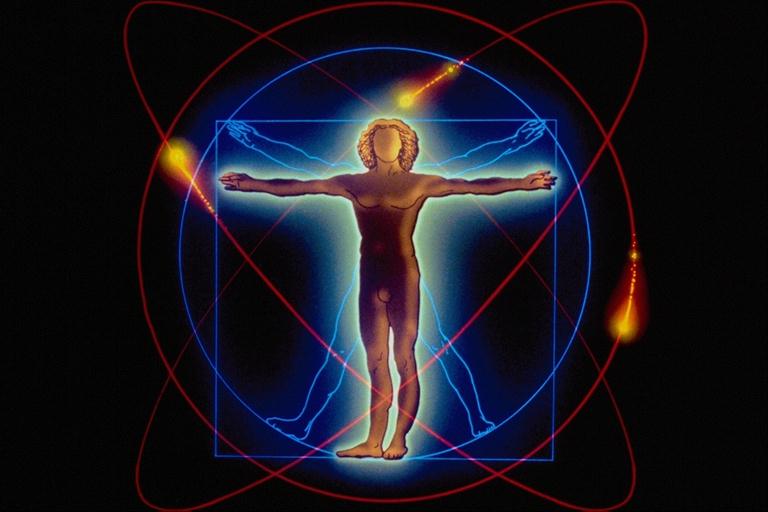 Science Shows Us We Are One Life |
Do we really have to continue to do this? | Carl Sagan - 1966 Interview on Astrobiology |
Enjoy.
© 2012 wonder404
 | Agnostic Science  ‘I cannot believe in a God who wants to be praised all the time.’ Mark Twain |
It is a capital mistake to theorize before one has data.
Insensibly one begins to twist facts to suit theories instead of theories to suit facts.
Arthur Conan Doyle
Science is Agnostic I am a scientist. What I use to discern things is the scientific method for arriving at facts and testable theories that make sense of these facts. As a guide, The Carl Sagan Baloney Toolkit is very handy in this regard.I'm also a zen buddhist. It's not a religion. There is no god to be worshiped. Nor is there a doctrine or scripture. Zen is a way of life. As to the argument of if there is a god, that is between Theists and Atheists, I am part of neither camp. I neither believe nor disbelieve in the proposition. I'm an Agnostic on this question. |  "The scientist is not a person who gives the right answers, he is one who asks the right questions." Claude Lévi-Strauss |
It ain’t what you don’t know that gets you into trouble.
It’s what you know for sure that just ain’t so.
Mark Twain
It’s what you know for sure that just ain’t so.
Mark Twain
 | "Ignorance is preferable to error; and he is less remote from the truth who believes nothing Thomas Jeffersonthan he who believes what is wrong." |
Do not condemn the judgment of another because it differs from your own.
You may both be wrong.
Dandemis
A Damn Good Argument Here's why I'm an agnostic. And it is because of the rigor of science that I have come to this conclusion. I won't make many arguments, only one question. Sagan's Toolkit provides one that should be asked.But You may still both be wrong. - "Ask whether the hypothesis can, at least in principle, be falsified (shown to be false by some unambiguous test). In other words, it is testable? Can others duplicate the experiment and get the same result?" So now, the hypothesis on the existence of god. A great deal of logic and philosophy and blind faith have gone into these debates from both sides. Both are based on belief. Yes, belief. Belief in the meaning of "confidence in the truth or existence of something not immediately susceptible to rigorous proof". Theists have yet to demonstrate any empirical evidence. But then neither have the Atheists any conclusive proof of the contrary. And while religion is definitely not value-free, many forget that atheists too, are not value-free. Strictly speaking, there is no data one way or the other. Based on science, that demands facts, the conclusion I come to is agnostism. I border between being a strong or a weak one. I'm open to any empirical proof but haven't seen any yet. Skeptical, I don't think there is one. "To kill an error is as good a service as, and sometimes even better than, the establishing of a new truth or fact." Charles Darwin | "The question [Do you believe in God?] has a peculiar structure. If I say no, do I mean I'm convinced God doesn't exist, or do I mean I'm not convinced he does exist? Those are two very different questions." Dr. Arroway in Carl Sagan's Contact  Historically, throughout many ages and cultures, alchemy was a union of protoscience and spirituality. Alchemy sought the purification and transmutation of both matter and spirit. Noble intent maybe, but it's not objective science.  "Skeptical scrutiny is the means, in both science and religion, by which deep thoughts can be winnowed from deep nonsense." Carl Sagan |
We should be teaching our children the scientific method and the reasons for a Bill of Rights.
With it comes a certain decency, humility and community spirit.
Carl Sagan
|
 | "The mystery of the beginning of all things is insoluble by us; and I for one must be content to remain an agnostic." Charles Darwin |
Enjoy
© 2014 wonder404


