Showing posts with label Banks. Show all posts
Showing posts with label Banks. Show all posts


Swiss GDP consists mostly of medium-sized companies which do not pay huge salaries to their bosses.
On 24 November 2013, Switzerland holds a referendum on reforms that would make it illegal for Swiss companies to give bosses more than 12 times the wage of their lowest earning workers.
In 1998, the top salaries at the largest Swiss companies stood at 14 times those of the lowest-paid workers.
By 2011, the top salaries at the largest Swiss companies stood at 93 times those of the lowest-paid workers.

Peter Brabeck, chairman of the Swiss firm Nestlé, earns 12 times more than the chairman of the Anglo-Dutch firm Unilever.
In 2011, Switzerland had the world's highest average wealth per adult, at USD 540,000.
However, wealth in Switzerland is now distributed very unequally.

In The Financial Times, James Breiding writes that Switzerland has been the most competitive country in the world due to having "strong industry and weak government, with low levels of regulation."
In 1998, the top salaries at the largest Swiss companies stood at 14 times those of the lowest-paid workers.
By 2011, the top salaries at the largest Swiss companies stood at 93 times those of the lowest-paid workers.
When big companies are run by greedy pigs, trouble follows.

It is the companies paying giant salaries, such as Credit Suisse and UBS, which have been 'badly managed' and which have got Switzerland into trouble.
By 2003, the Swiss economy was under some stress and there were a number of bankruptcies and "massive layoffs and dismissals."
Among the reasons for this were:
1. The Global economic crisis, partly caused by 'the greedy pigs' grabbing more than their fare share of the world's wealth.
2. The ordinary Swiss family getting less than their fair share of the cake and feeling that they had less money to spend.
Peter Brabeck, chairman of the Swiss firm Nestlé, earns 12 times more than the chairman of the Anglo-Dutch firm Unilever.
In 2011, Switzerland had the world's highest average wealth per adult, at USD 540,000.
However, wealth in Switzerland is now distributed very unequally.
Urs Rohner, the chairman of Credit Suisse earns more than the chairmen of Barclays, BNP, Deutsche Bank and Royal Bank of Scotland combined.
(In 2003 Switzerland's real GDP contracted by 0.2%.)

If chief executives' pay is capped at about $500,000 per year, Switzerland might get rid of some of the greedier hedge fund managers and bank executives.

It is the companies paying giant salaries, such as Credit Suisse and UBS, which have been 'badly managed' have got Switzerland into trouble.
James Breiding is the author of ‘Swiss Made: The Untold Story Behind Switzerland’s Success’.
Switzerland has attracted multinationals, including Google, consumer goods company Procter and Gamble, commodities traders such as Cargill, Glencore and Louis Dreyfus, and hedge funds such as Brevan Howard.
However, these companies do not necessarily employ large numbers of Swiss citizens, and do not necessarily pay much in tax.
These multinationals do not necessarily do much to enrich the average Swiss citizen.
If chief executives' pay is capped at about $500,000 per year, Switzerland might get rid of some of the greedier hedge fund managers and bank executives.
It is the companies paying giant salaries, such as Credit Suisse and UBS, which have been 'badly managed' have got Switzerland into trouble.
Some of the top executives in Switzerland would appear to very greedy.
Peter Brabeck, chairman of the Swiss firm Nestlé, earns 12 times more than the chairman of the Anglo-Dutch firm Unilever.
Walter Kielholz, chairman of reinsurer Swiss Re, earns 10 times the salary of Germany's Munich Re.
Urs Rohner, the chairman of Credit Suisse earns more than the chairmen of Barclays, BNP, Deutsche Bank and Royal Bank of Scotland combined.
http://www.ft.com/

Swiss GDP consists mostly of medium-sized companies which do not pay huge salaries to their bosses.
If one or two hedge funds were to leave Switzerland, it would not be the end of the world.
Urs Rohner, the chairman of Credit Suisse earns more than the chairmen of Barclays, BNP, Deutsche Bank and Royal Bank of Scotland combined.
http://www.ft.com/
Swiss GDP consists mostly of medium-sized companies which do not pay huge salaries to their bosses.
If one or two hedge funds were to leave Switzerland, it would not be the end of the world.
Swiss GDP consists mostly of medium-sized companies which do not pay huge salaries to their bosses.
These medium-sized companies are world-class.
It is the companies paying giant salaries, such as Credit Suisse and UBS, which have been 'badly managed' and which have got Switzerland into trouble.
It is the companies paying giant salaries, such as Credit Suisse and UBS, which have been 'badly managed' and which have got Switzerland into trouble.
Journalist Iain Macwhirter writes that: "There was confirmation last week that an independent Scotland would not only be economically viable, but could have a highly successful and diverse economy with a healthier credit rating than the UK."
IScotland Would Be Oil Rich And Creditworthy Even Without The Banks - 2 March 2014
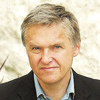
Iain Macwhirter
According to Macwhirter:
1. "Scotland is on the cusp of another oil boom, according to a report from Sir Ian Wood, commissioned and endorsed by the UK Government.
"It said there are still up to 24 billion barrels of recoverable oil, worth about £200 billion in additional revenue, and £1 trillion-£2trn in reserves."
St Andrews
2. "According to one of the world's biggest rating agencies, an independent Scotland might have a AAA credit rating even without taking the oil into account."
Standard and Poor's said that "losing some of the big banks might be a benefit to an independent Scotland as a top-heavy banking sector could cause trouble if one institution went bust."

4. The insurance giant Standard Life "apparently briefed the press that it might take 5000 jobs out of Scotland.
"Some internal sources suggest that the number being talked of is only 50.
"Standard Life made similar noises in the early 1990s over the prospect of Scottish devolution. You might have thought that would make it wary of crying wolf again - especially as its pre-tax profits fell last year by 13%."

The Clyde
5. Barclays chief executive Antony Jenkins said last month that he "can make it work either way" on independence.
British Airways has also distanced itself from the debate, saying it might even benefit from an independent Scotland.

Glasgow
6. Royal Bank of Scotland announced last week that it was preparing to leave, because of the "political risks" of independence.
"Some might think this no great loss, given that the bank had just reported losses of £8bn, while shamefully paying its bosses £500 million in bonuses.
"Let the rest of the UK take on the toxic balance sheet of the bank that almost single-handedly destroyed the UK economy and has lost more than £40bn in the last few years."

Comments from readers of the Sunday Herald include:

Dr Douglas McKenzie
"What has shocked me this week has been... the BBC's complete blanking of the Standard and Poors report which I believe to be probably the most important document in the debate so far...
Alex Holmes, Isle of Arran
"Unfortunately, voters are visually assaulted daily by the lurid, doom'n'gloom headlines of the London controlled rags in the newspaper stands."
Iain Lawson, Paisley .
"The financial position and level of debt within the UK economy is eye watering... International finance will start to study the consequences of ... the wealthy, asset rich Scotland being lost to the London borrowers."

Tony Little
"The FT considers that iScotland would start life with a sound economy, and many independent economists think that iScotland would have very little need to borrow."
~~~


